
“The weakest information is based on a single case or a single expert’s opinion. Traditions, myths, or ‘just-the-way-we’ve-always-done-it’ are similarly weak until tried with scientific method and proven to be effective and good for the horse.”
― Dr. Stephen Peters: Evidence Based Horsemanship
For the last couple of months I’ve been offering up some fiction books, which is a rarity for me. Today I’m back to a nonfiction book.
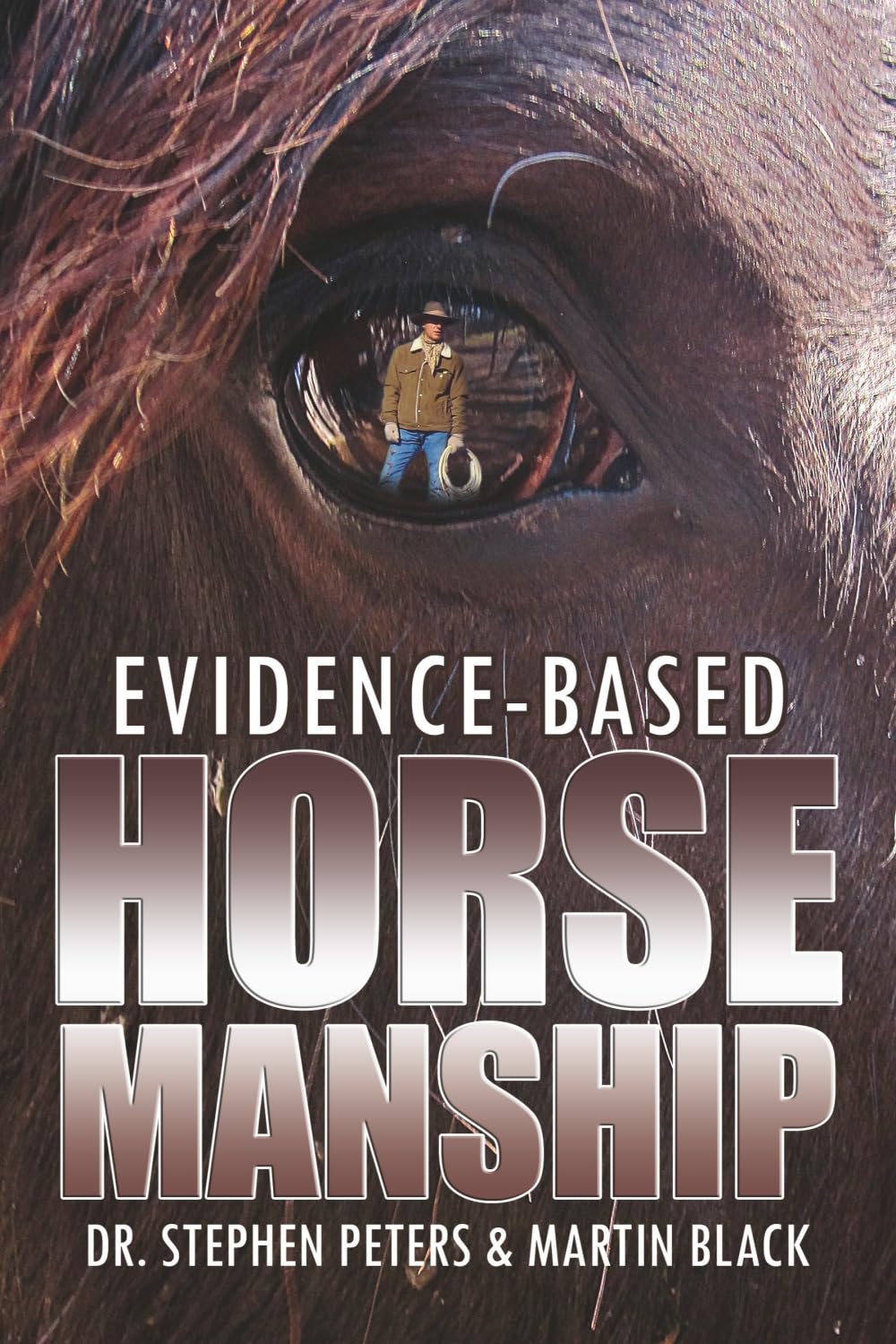
At the recommendation of you wonderful readers I picked up Evidence Based Horsemanship written by Dr. Stephen Peters and Martin Black.
This book is NOT part of the Trafalgar Square publishing group or Stable Book Group. Evidence Based Horsemanship was originally self-published in 2012 through Wasteland Press. The short book covers seven chapters in under 100 pages.
Dr. Stephen Peters
Dr. Stephen Peters is a neuroscientist who spend years as a founder and director of the American Fork Memory Clinic and Utah Valley Clinic for Brain Health. Over the years he has combined his profession with his passion for horses. His goals are to help horses by educating people about brain science in a way that improves their horsemanship. He has been invited to speak on world stages such as the Spanish Riding School in Vienna. He has collaborated with and continues to collaborate with horse trainers as well as other scientists to further develop our understanding of the horse’s brain.
Visit Dr. Stephen Peters at: https://www.horsebrainscience.info/
“The horse spooks on the opposite or untrained side because of the independent connections of the optic nerves. Evolution has determined that a horse who spends too much time in thought will be eaten.”
― Dr. Stephen Peters: Evidence Based Horsemanship
Martin Black
Martin Black is a cowboy who grew up on his family ranch in Idaho. He has known and worked with horses all his life and learned under some of “the greats” like Tom Dorrance. He has started multi-million dollar horses and places importance on timing. He seeks to teach people to grow their skills and abilities to work with any horse.
Visit Martin Black at: https://martinblack.net/
“We may be at the same place and see the same thing as a horse and come away with a totally different impression of the experience. We may remember is as a very pleasant experience and the next time the horse is at the same place he may be terrified.”
― Martin Black: Evidence Based Horsemanship
The Book
Together these men have coupled their knowledge to create what I’m sharing with you today. Evidence Based Horsemanship. Inside this short book is a blend of science combined with the practical application in the horse world.
“When we are too passive, horses may get bored and lose interest with us and if we are too aggressive they can get too protective. But when we get the balance just right the horse can operate at a place where he is interested but not worried. The more they can experience operating at this place, the more they look for this place because it feels good to them.”
― Martin Black: Evidence Based Horsemanship
We begin the book at the most simple and basic structures and myelination. This chapter is very technical and we don’t get any input from Martin just yet. But this chapter helps with the building blocks of what’s next.
We continue on to learn about the structures that make up the brain. The cerebellum, thalamus, amygdala. We learn what these structures are used for and what we see when we work with a horse.
Chapter three begins to discuss the senses and how horses perceive the world around them. These key details help the reader appreciate how the horse is processing stimuli and how something we do with or to the horse can affect its experience.
In chapter four we learn about the horse’s fear response. There’s a big emphasis on balance in this chapter. Just like humans, horses can’t learn when they are pushed to the extreme. The men discuss how and why this works and what cues to look for when working with a horse.
We next move on to how horses learn and their memory.
Chapter six unpacks the consequences of what happens if a horse is inhibited from it’s natural behaviors. We briefly discuss grazing as well as some bad habits like cribbing.
We finish off with a brief note and warning against anthropomorphism. I am guilt as anyone of anthropomorphizing my horse is some ways. I simply joke about his motives. In reality I know better and don’t ACTUALLY believe those comments. No matter what we do we must always consider the horse’s actual biology in order to keep them happy and healthy. This final chapter discusses exactly that.
“When horses find that no matter how they respond they cannot escape from pain or adverse stimuli, they may initially respond with fight or flight responses. When these responses are ineffective and produce no release no matter how they respond, they are at risk for developing learned helplessness.”
― Dr. Stephen Peters: Evidence Based Horsemanship
I really appreciate how this pair was able to collaborate in order to present scientific data couple with real life experiences and examples. It was a format I haven’t yet seen and I think they pulled it off well. They also separated each author’s contributions in a way that made sense and it was clear.
The brevity of this book makes it a quick read, but the technicality means you need to slow down in order to digest the information.
Because the book is so short, Dr. Peters offers quick facts but omits long discussions into the details and the data; someone who isn’t very “science-y” may love that about this book (While I love the nitty gritty). Similarly, Martin Black offers his narration of images, which are incredibly helpful to illustrate his point….but he doesn’t dive into deeper conversation about what they present.
I would love to see a version of this book that goes further. Deeper into the actual working with the horse and the training. This may be a more difficult task but I was hoping for more training related content.
“When a horse panics, it is in a reactive state. Instincts take over and it doesn’t give any thought to its actions. The horse learns very little if anything in this state of mind because it’s going off instincts.”
― Martin Black: Evidence Based Horsemanship
Final Word:
Having a background in biochemistry and a passion in horses I personally found this book to be an excellent starter for most horse people. The facts are simply stated and the explanations are clear. Over the decades I have already learned most if not all of what was presented in the book but I still enjoyed the way it was presented. We still live in an age where it’s not always normal to consider a horse’s natural states. Indeed we have come a long way from where we were but many barns still apply outdated philosophies and training practices that don’t have a horse’s best interests in mind.
This book is an excellent starting point to help horse people who want to improve their horses’ lives.
Both men have additionally published other works which might offer more guidance (I believe though have not personally read the other books). I would also suggest Dr. Janet Jones’ Horse Brain Human Brain as a “deeper dive” into how horses perceive the world and how they think. (The Sunday Review: Horse Brain Human Brain by Janet Jones, PhD).
“Statements such as ‘I’ve been doing this for 50 years’ doesn’t negate the fact that someone can do something wrong for 50 years.”
― Dr. Stephen Peters: Evidence Based Horsemanship



Leave a Reply