
It’s a running joke in some popular horse groups on Facebook…maybe it has ulcers…needs turmeric. It’s funny because people on the internet immediately jump right to these conclusions with every post with uncertain conditions. I laugh and joke, too; it does seem ridiculous.
But just because it’s a joke doesn’t make it completely untrue. The fact is…many horses have ulcers. Working horses, pleasure horses, even feral horses have ulcers. They are lesions within the GI tract that can be incredibly painful. In many cases there are no clinical signs until they become severe.
You might think your horse isn’t at risk….but is that true? Of horses NOT in work research has shown 37-52% of thoroughbreds, 38-56% standardbreds, and 48% of endurance horses. IN work the numbers rise to 100%,72-88%, and 57-93% respectively. It’s not just these populations either. Western folks…79% of western pleasure horses have ulcers. Feral horses in the UK? 61%. Ulcers are ever present.
Back in 2021 I published a series of educational posts to help you learn and understand the GI tract in horses. If you missed it they are here:
- Monthly Topic: The Digestive System
- Monthly Topic: Microbiome
- Monthly Topic: Ulcers
- Treating and Maintaining Ulcers

I’m returning to give you some updates to that series and supplement you with current knowledge.
*Disclaimer: I am not a student and I am not preparing a master dissertation so these research articles I write for you are minute in comparison to what would be adequate for the academics. This research I do is for fun, because I’d love to be a student for life. Learning and presenting data in a way that everyone can appreciate it is a passion of mine. I don’t always have access to some research articles and I don’t always have a ton of time but I do what I can. I will always include links to my resources but I have done away with the academic bibliography format.*
As you may know horses generate acid 24 hours a day, 1.5L PER HOUR. By evolution this works great because they are meant to graze 23 hours each day. The acid is then available to break down large particles and starches in their forage before sending it on to the cecum. The saliva produced is alkaline, and grazing produces a lot of it so that helps to buffer the acid and raise the pH a bit.
How Ulcers Are Formed:
- Stress. When horses are stressed, they eat less and/or produce more stomach acid.
- Fasting/Lack of forage: When horses are fasted, there is less content in the stomach to utilize the acid and less saliva to buffer it….and fasting is also stressful.
- Exercise: When horses run and work, contents in the stomach acid slosh, which can splash onto unprotected areas of the stomach. It’s also suspected that the contraction of the body can squeeze the stomach, creating more risk.
- Diet: Horses that eat concentrated feeds high in starch are at risk because the starch is broken down in the stomach, and a byproduct is volatile fatty acids (VFAs) which lower the overall pH (more acidic).
- Pharmaceuticals: Specifically Non Steroidal Anti-Inflammatory Drugs (NSAIDs). These drugs, while good at relieving pain, come at a cost. They can wreck havoc on a horse’s GI tract and induce ulcers.
What the result is from this acid and very low pH is ulcers…painful lesions and permeability within the GI cells.
There are two main types (aside from hindgut) that vets are most interested in. The first is Equine Squamous Gastric Disease (ESGD) which is found in the upper half of the equine stomach that is unprotected by a mucous barrier. The other is Equine Glandular Gastric Disease (EGGD), where the lesions are damaging the lower half of the stomach and interrupting the existing protective mucous layer.
You can read more about all of this in my previous posts listed above.
Today I’m updating with new studies that have occurred to help us gain better understanding.

In 2021 a study out of Texas A&M looked at the use of nutraceuticals while administering NSAIDs. This was a study financially supported by Platinum Performance and the group used Platinum Performance GI in the study. That said, Platinum Performance had no say in the experiment design or publishing of the paper. The experiment was blind, coded in a way to prevent users knowing which test group was which. Additionally, placebos were created to mimic the test group. In other words the group took measures to prevent bias.
In the study thirty horses were tested. One group was a control, given a placebo paste with no NSAIDs. One group was given phenylbutazone paste (bute). The third was given bute with the platinum performance GI supplement.
What this group found was interesting…6 of the ten horses given bute only developed ulcers. Only one horse developed ulcers (grade 2) with the combination of bute and Platinum GI.
The bute group pf horses also showed differences in their fecal microbiota while the group supported with the nutritional supplement seemed to maintain a stable microbe environment. The authors noted a loss of microbes belonging to the firmicutes phylum, specifically the lachnospiraceae family, and more specifically the pseudobutyivbrio genus. This group of microbes plays an important role in producing butyrate which is part of the biochemical requirements of the GI tract cells.
I found this study interesting and it demonstrates that by supporting the GI system you can work to prevent ulcer formation while giving NSAIDs.
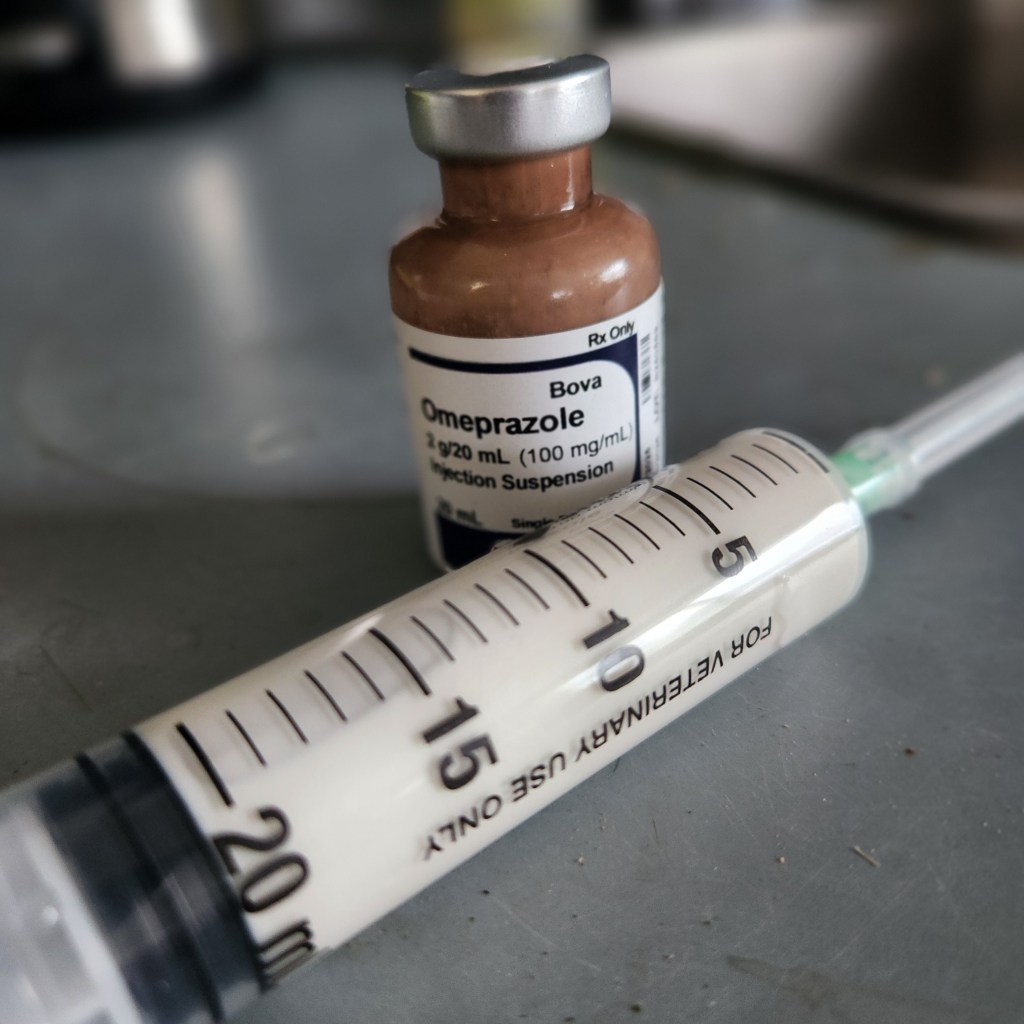
Even more interesting the authors also discussed the fact that using omeprazole in conjunction with NSAIDs in humans actually makes ulcers more severe. That was a surprising detail! It hasn’t been studied in horses yet but I’d be more averse to giving omeprazole while I have NSAIDs to my horses. Instead it seems more worthwhile to support the GI system.
The authors speculate that NSAIDs damage the intestinal epithelial cells leading to permeability within the cells. NSAIDs are also thought to reduce the mucus production while damaging the intestinal barrier.
Platinum Performance GI contains prebiotics, probiotics, glutamine, biosponge, antioxidants, and omega-3 fatty acids. It would be reasonable to believe that this supplement’s specific formula is an excellent source and option to help support a healthy GI system within your horse.

A study in 2023 out of Italy compared formulations of omeprazole in the treatment of ulcers. They studied 30 horses; 7 were given gastro resistant granules containing omeprazole. 7 horses were given granules without the compound. 8 horses were given a powder paste formula of omeprazole and 8 were given a powder paste without the compound.
After 28 days the group with the gastro-resistant granules experienced the greatest recovery. 100% experienced lower ESGD scores, four of them were completely healed. The two horses in this group that also had EGGD were healed. The placebo group had mixed results…some ulcers were healed and some developed ulcers.
The powder paste group experienced some healing. One horse was not able to be evaluated so of the seven left, three were completely healed (from 2 and 3), one was improved to a grade 2 from grade 4, and three with grade 4 ESGD had no change. Two horses were healed of EGGD and one horse even developed EGGD. The placebo group had virtually no change and all continued to suffer from ESGD.
In the past I have purchased (and still use) compounded omeprazole powder with the understanding that it could be less effective. The second article demonstrates that exact assumption. Currently the only option that is approved and uses the enteric coating in the United States in Gastrogard, with the preventative option being UlcerGard.
Another company I have had interest in over the years is Abler. Unfortunately this company is not FDA approved and the recipient of several warnings from the government beginning in 2015. Ask online and you’ll find very mixed reviews. While I love the idea that these granules are enteric coated there have been comments regarding the omeprazole dosing being inconsistent. The company doesn’t seem to have any response to the accusations. The lack of transparency and acknowledgement concerns me. I also find it concerning that in the past ten years it doesn’t appear they’ve made any moves to have the formulation studied. I’d love to see the quality assurance on this. I’m sad about it because I’d love to see a more competitive market of products (FDA approved). You can still try these but know that you’re giving them at your own risk.
I’m always looking for new and better ways to care for my horses and ulcers are routinely at the forefront of my attention.
I read a few additional articles that summarized new information based of other research available. I noted a few important findings that might be useful in your endeavors against Equine Gastric Ulcer Disease.
- Horses that are fasted overnight show better response to omeprazole. Their circadian rhythms make fasting overnight the preferred timing of choice. The suggestion is to fast overnight and dose with oral omeprazole 30 minutes before feeding.
- In the UK, Australia, and Canada there are formulations of intramuscular omeprazole administered every 5 days that show 97% effectiveness against ESGD and 93% effectiveness against EGGD. This formulation has low rates of injection site reactions. Unfortunately in the United States we do not have access to this option. The option for IM omeprazole in the US is risky…less effective and comes with a 48% change of injection site reactions by the 4th dose. How do we get the new formulation here?
- Omeprazole can increase serum gastrin concentrations making it risky to discontinue use (but it is more risky to use it long term). They did not recommend tapering off if the timeframe is less than 8 weeks. Instead it was recommended that care be taken for the first 48 hours post treatment. They recommended no riding or stressful events, plenty of forage, and no trailering to help the horse readjust to it’s normal system. Otherwise you can bring ulcers right back.
- There was a recommendation to exercise horses in the afternoon when they have been eating forage all day.
- As little as 300g (~2/3lbs) of forage prior to work has been shown to provide significant protection.
- There was another recommendation to rest horses 2 (ideally 3) days each week.
- There are other supplements that have been notable in providing some protection.
- Fish oil: The Omega-3 ratios in fish oil have shown to be more effective than other options
- Licorice: There was no explanation on the mechanism of this ingredient, however multiple studies utilizing this in combination with other feedstuffs have shown to play a role in healing and prevention of ulcers.
- Pectin-Lecithin Complexes: Beet pulp is one of these, and feeding it has shown to reduce risk of ESGD
This data is still incomplete but I’m hoping you can take away some interesting information from it.

Additional Reading:
- van den Boom R. Equine gastric ulcer syndrome in adult horses. Vet J. 2022 May-Jun;283-284:105830. doi: 10.1016/j.tvjl.2022.105830. Epub 2022 Apr 25. PMID: 35472513.
- Vokes J, Lovett A, Sykes B. Equine Gastric Ulcer Syndrome: An Update on Current Knowledge. Animals (Basel). 2023 Apr 5;13(7):1261. doi: 10.3390/ani13071261. PMID: 37048517; PMCID: PMC10093336.
- Whitfield-Cargile CM, Coleman MC, Cohen ND, Chamoun-Emanuelli AM, DeSolis CN, Tetrault T, Sowinski R, Bradbery A, Much M. Effects of phenylbutazone alone or in combination with a nutritional therapeutic on gastric ulcers, intestinal permeability, and fecal microbiota in horses. J Vet Intern Med. 2021 Mar;35(2):1121-1130. doi: 10.1111/jvim.16093. Epub 2021 Mar 3. PMID: 33656183; PMCID: PMC7995434.
- Busechian S, Conti MB, Sgorbini M, Conte G, Marchesi MC, Pieramati C, Zappulla F, Vitale V, Rueca F. A Comparison of the Efficacy of Two Omeprazole Formulations in the Treatment of Equine Gastric Ulcer Syndrome in Racehorses: A Blinded, Randomized Clinical Trial. J Equine Vet Sci. 2023 Jul;126:104296. doi: 10.1016/j.jevs.2023.104296. Epub 2023 Mar 31. PMID: 37003396.


 The Green Horseman
Leave a comment